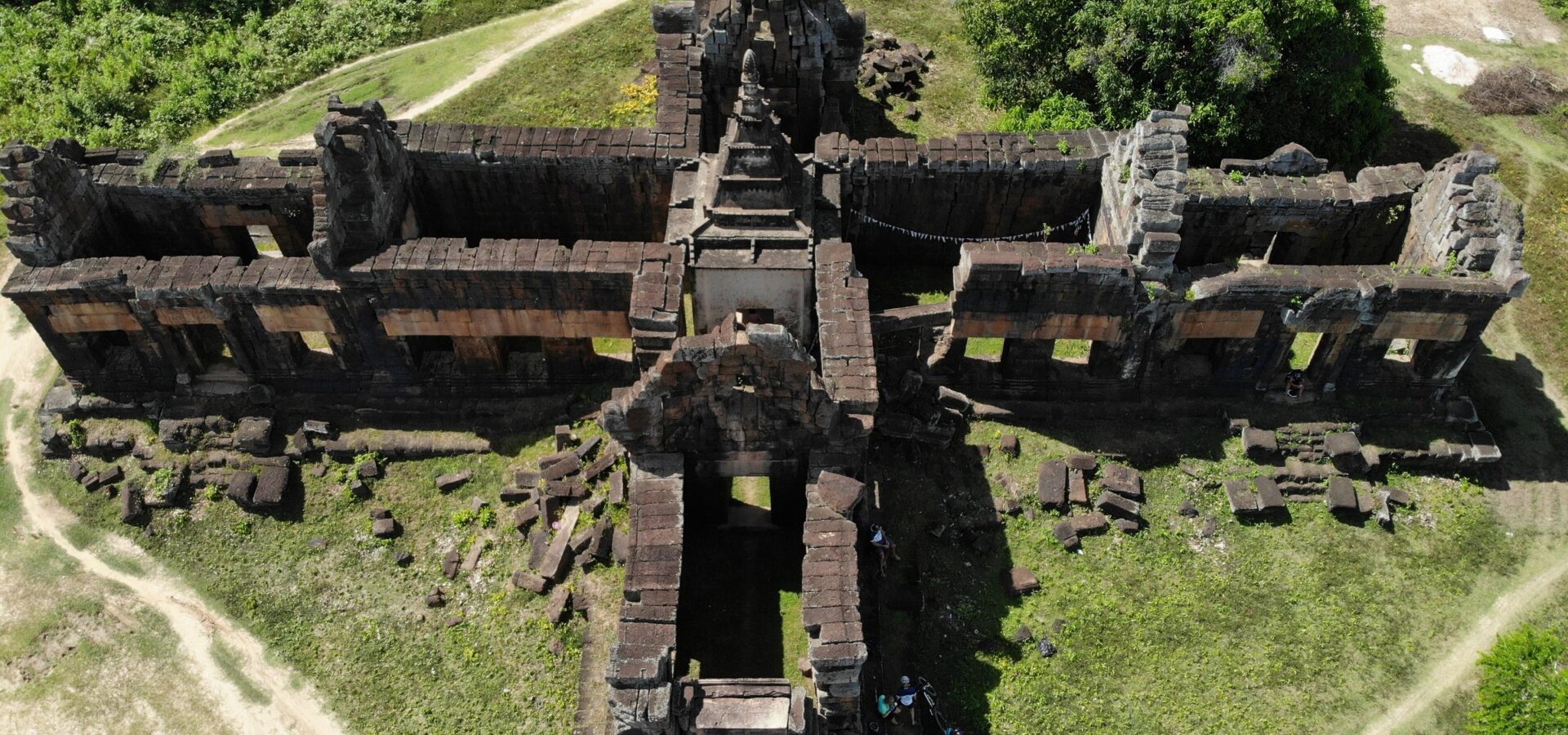
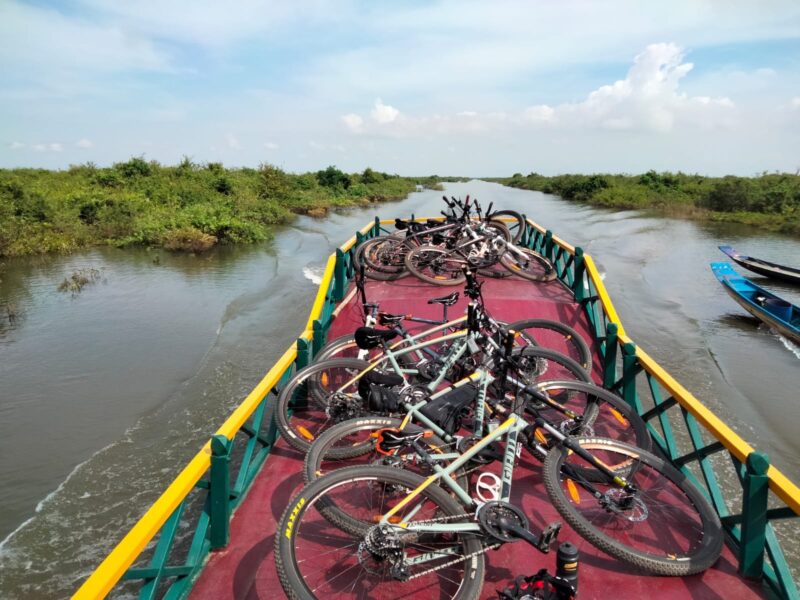
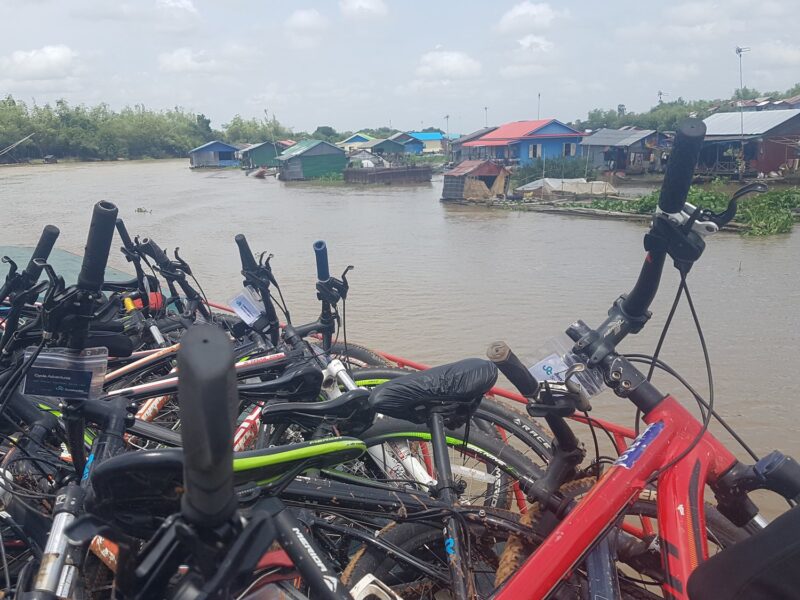
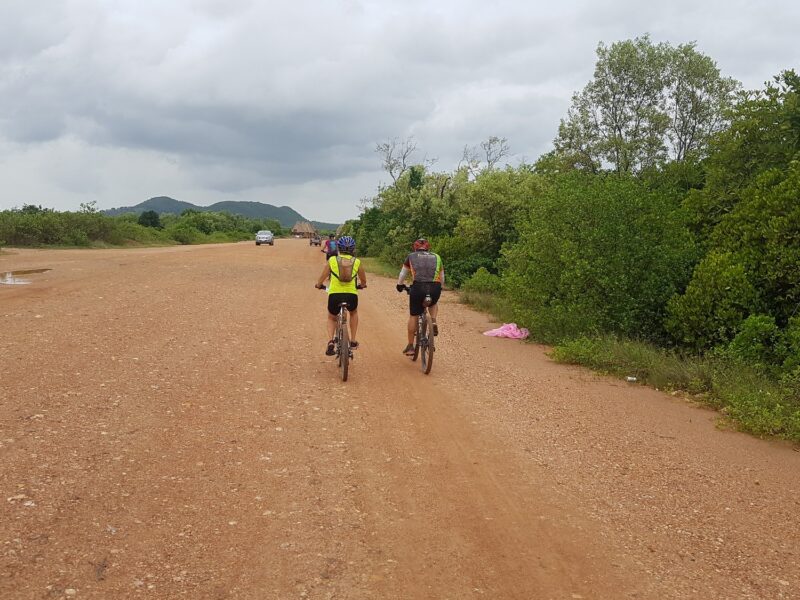
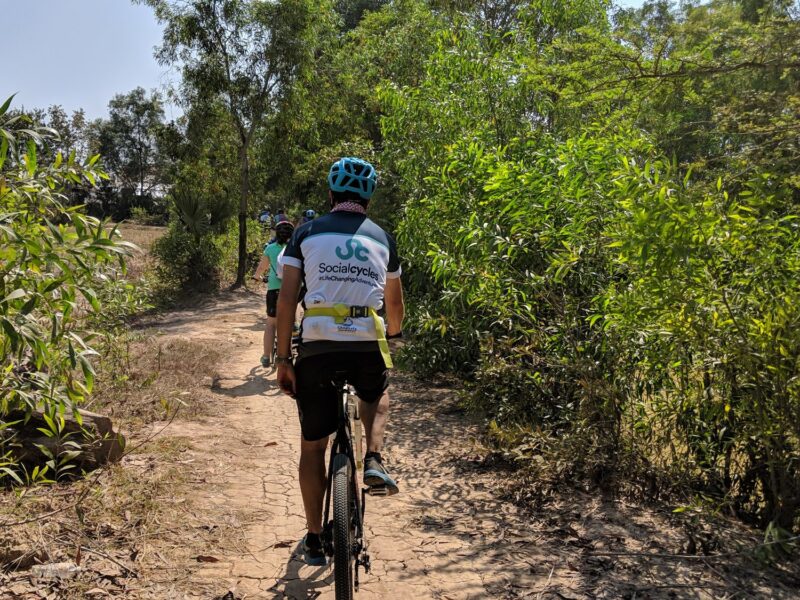
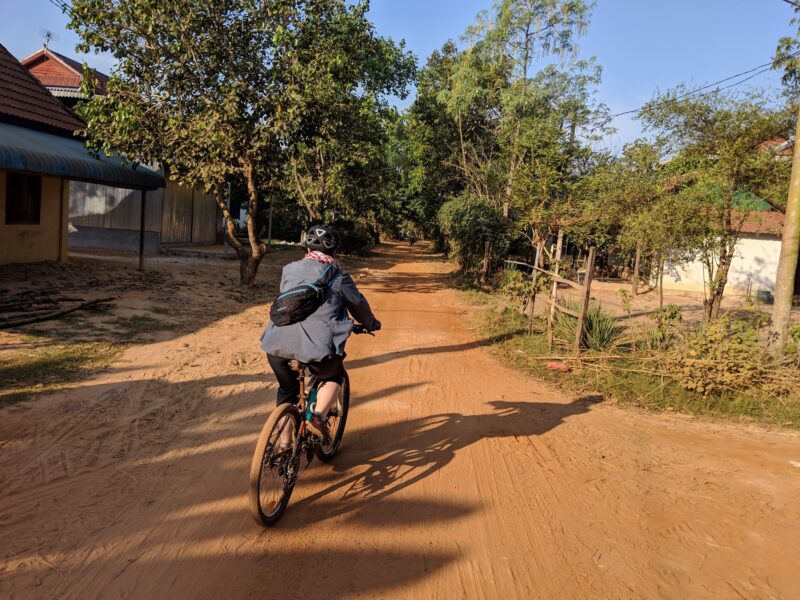
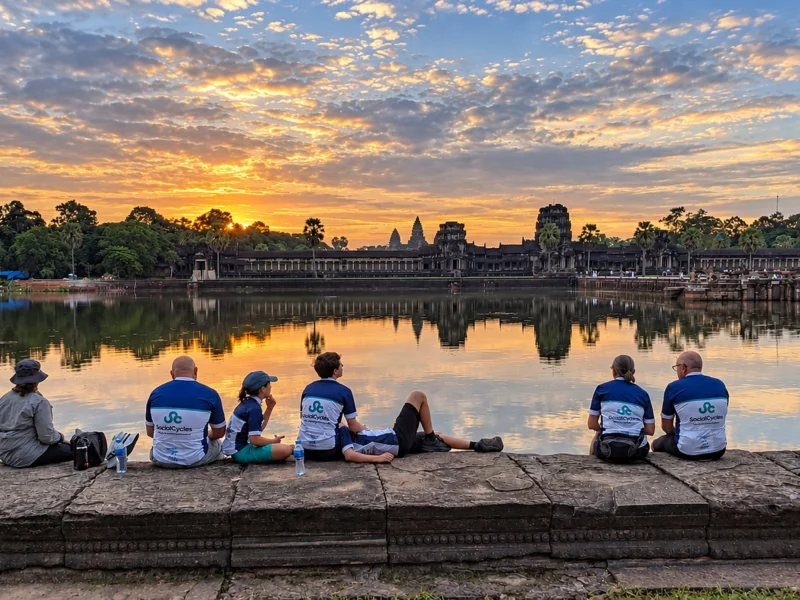
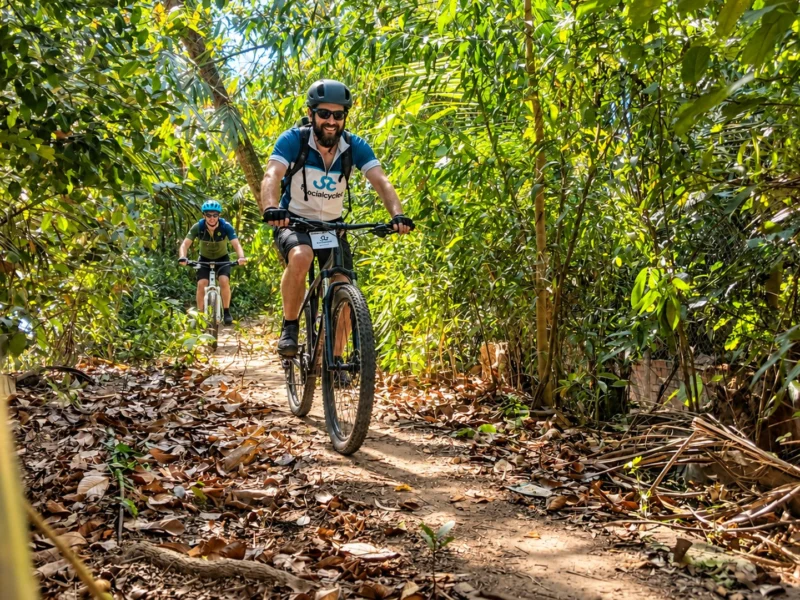
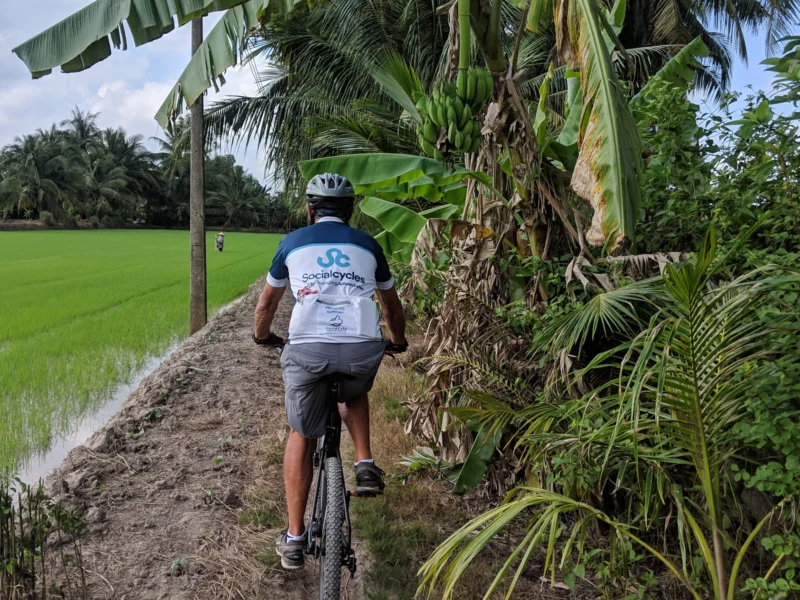
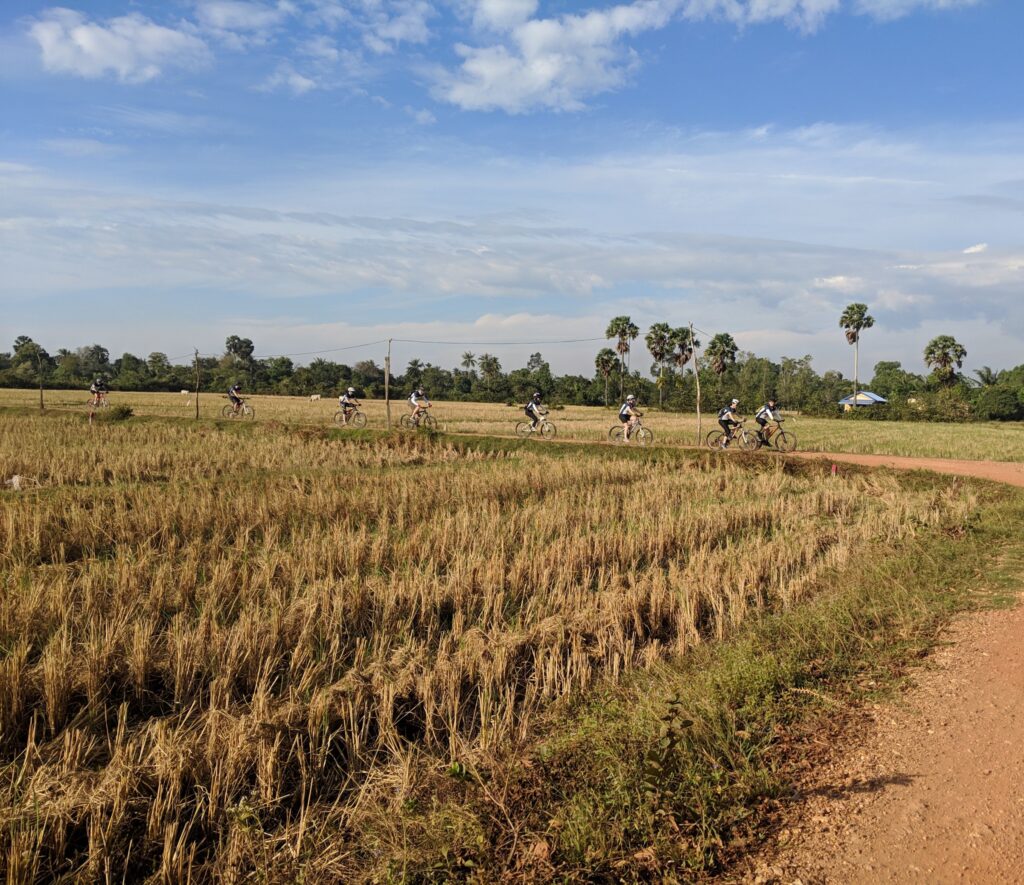
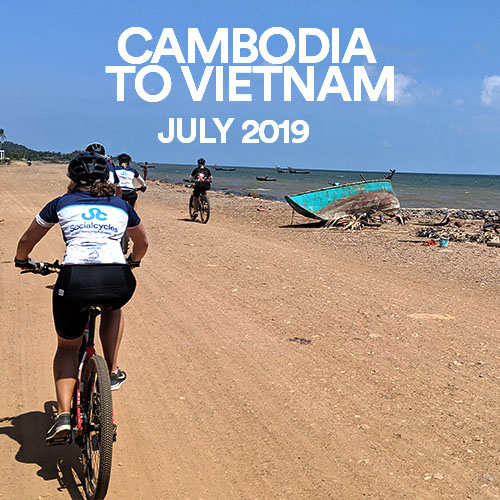
Cambodia is flat and hot, and people call hello from the roadside all day. From Siem Reap the riding starts with sunrise at Angkor Wat, on the bikes from 4.30 am, and a morning among the other temples. After that the roads get smaller. There is a boat across the Tonle Sap wetlands, single track into Battambang, dusty red back roads out to Banan Temple, and 75 km through villages on the Tonle Sap to the front door of the hotel in Phnom Penh.
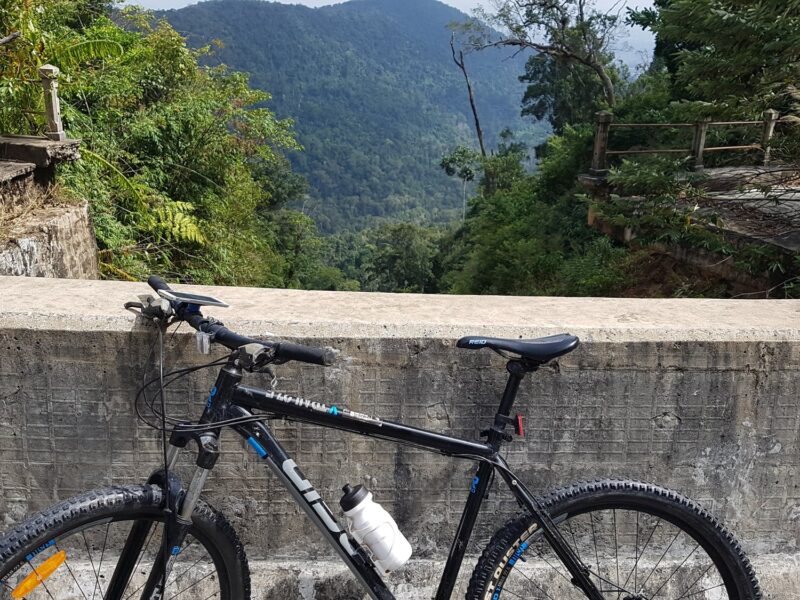
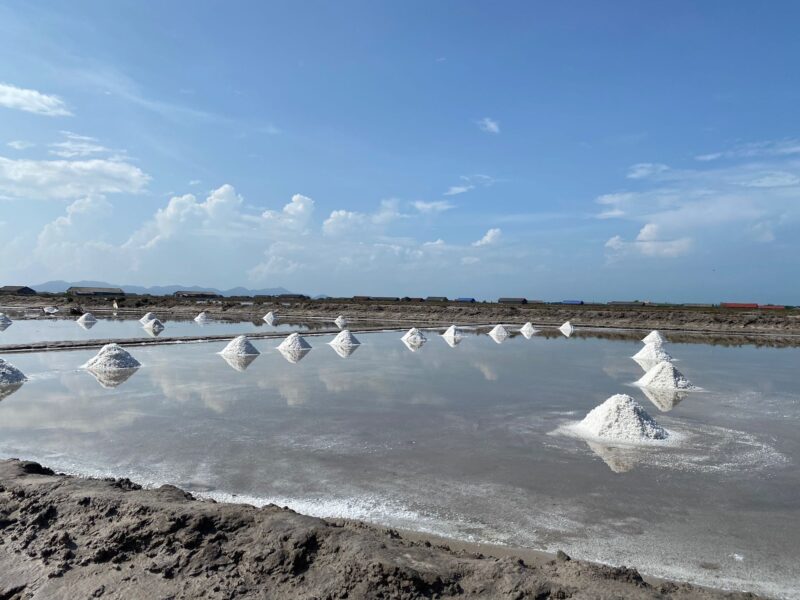
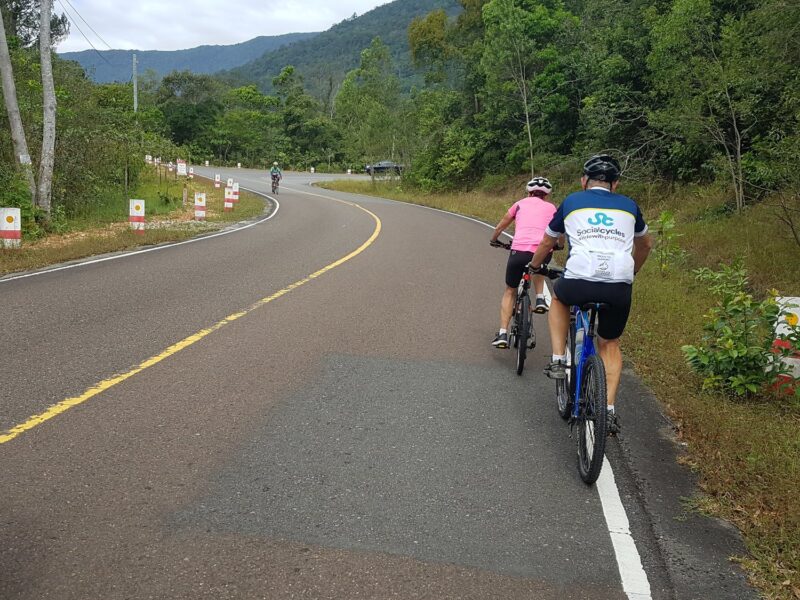
The longer rides carry on south to Kampot, on the coast, for the salt fields, the pepper farms around Kep and a Khmer cooking class. The climb up Bokor Mountain is optional: 30 km to the top, the first 10 flat. If climbing isn’t for you, the van takes your bike up and you ride down.
In Phnom Penh you meet Friends International and visit the S-21 genocide museum. It is a hard visit and we recommend it. Some rides stay in Cambodia. Others cross the border at Ha Tien and finish in Saigon.
“Our ride with Brett from Phnom Penh to Ho Chi Minh City was one of the most memorable trips I have ever done. A real odyssey on so many levels. We are still baking in the afterglow.”
When We Ride
2026JFMAMJJASOND2027JFMAMJJASOND
Months with a departure on the calendar. 2026: December. 2027: January to March, May to December.
Flat, on a mix of paved roads and compact dirt and gravel. Most riding days are 30 to 75 km. The one climb, Bokor Mountain, is optional.
The Impact
Every Cambodia ride meets Friends International in Phnom Penh. Rides from Siem Reap start with This Life Cambodia on their second day and also visit Sustainable Cambodia in Pursat, and rides through Kampot visit Chumkriel Language School. At the end of the ride, you choose the organisation that impacted you the most, and we’ll contribute 200 AUD on your behalf. Read about the impact and how the giving works →
01
What We See
You start among the temples of Angkor, on the bike from 4.30 am for sunrise over Angkor Wat. A boat then carries you across the Tonle Sap wetlands towards Battambang, a town of colonial-style streets, and dusty red back roads lead out to Banan Temple. In Phnom Penh you walk through Tuol Sleng, the S-21 Genocide Museum, after a morning with Friends International. The longer rides go on to the ancient ruins of Chisaur Mountain Temple, and then to Kampot on the coast: Bokor Mountain, the salt fields, and the pepper plantations and salt lakes of Kep on the way to the border at Ha Tien.
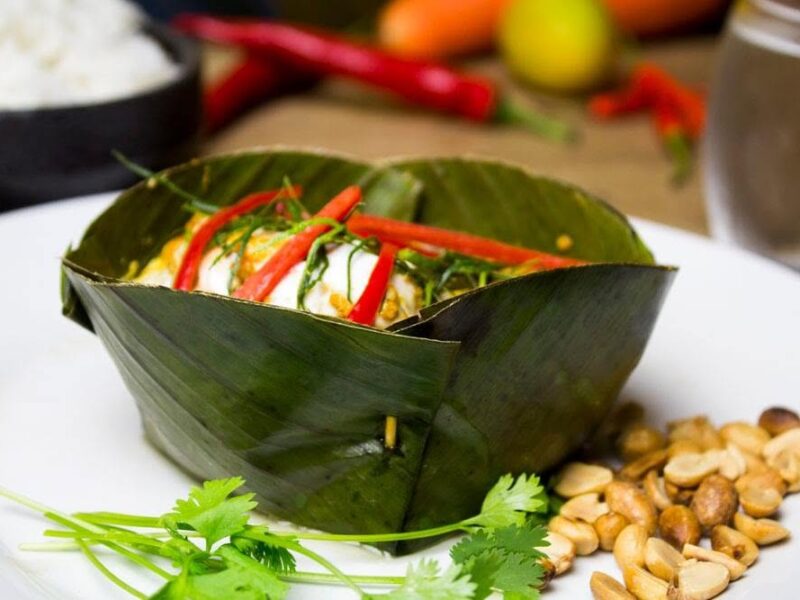
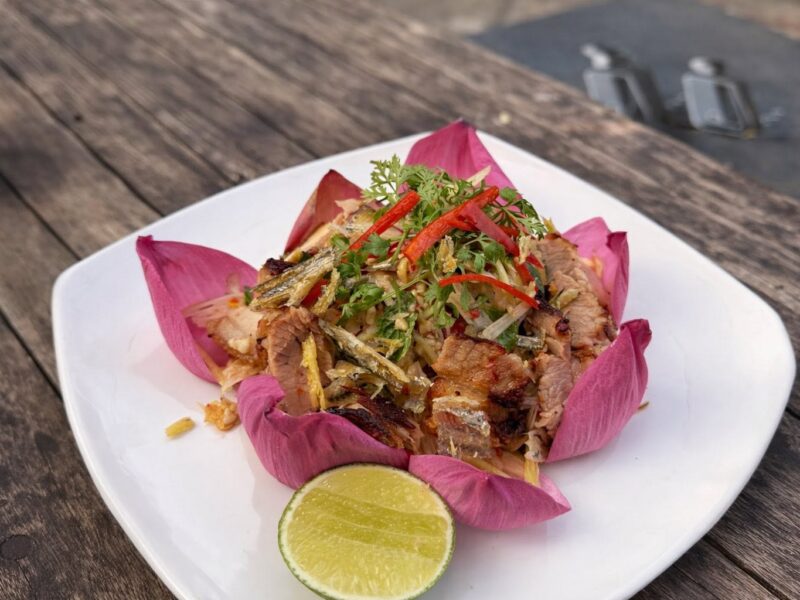
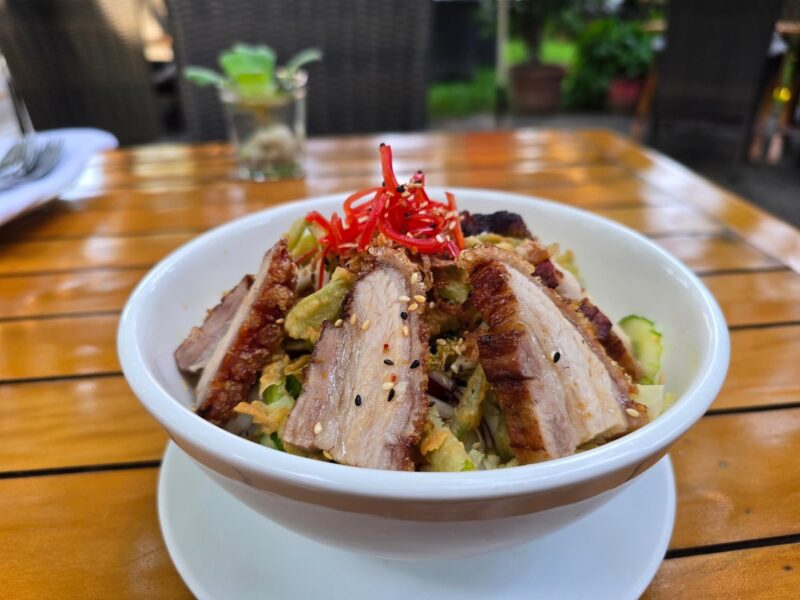
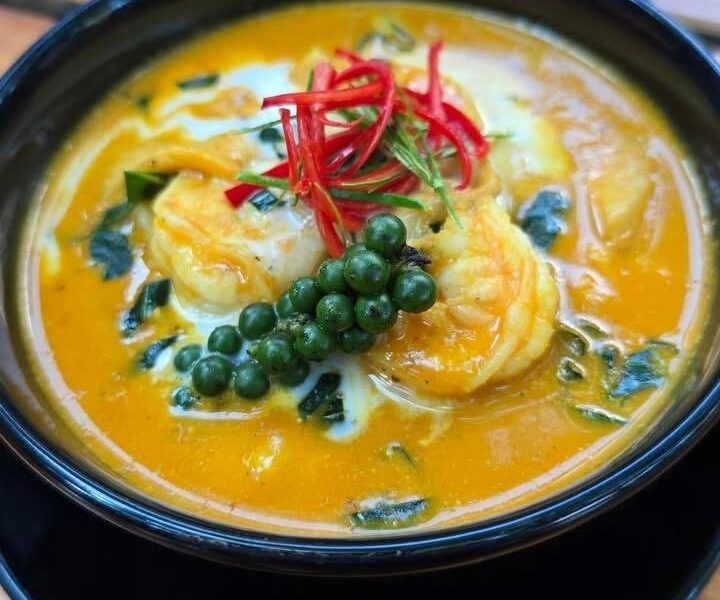
Your first dinner, in Siem Reap, is at Marum, a restaurant run by Friends International as a training ground for marginalised young people. In Battambang, dinner is at Jaan Bai, another social enterprise restaurant. Phnom Penh brings a Khmer barbecue, and Kampot a Khmer cooking class. On the ride south, lunch is at Chisaur Temple, and Kep, just before the border, is known for its fresh seafood, crab above all. Breakfast is included on most days, with some lunches and dinners. Each day of the itinerary shows which. Drinks are not included with meals, and the support van carries water and fruit on riding days.
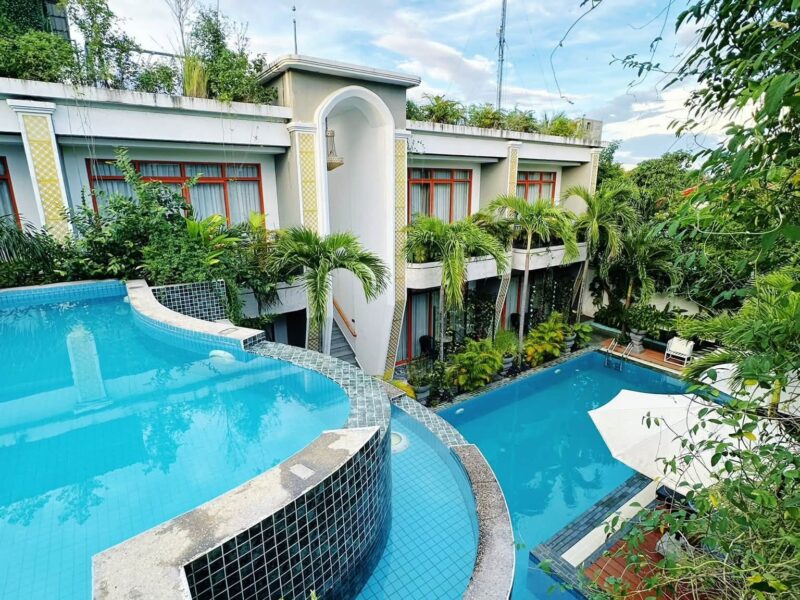
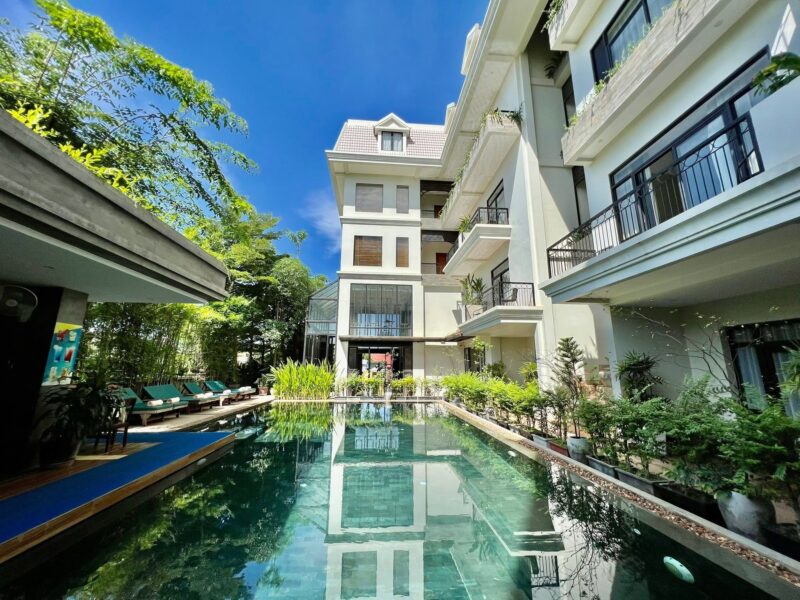
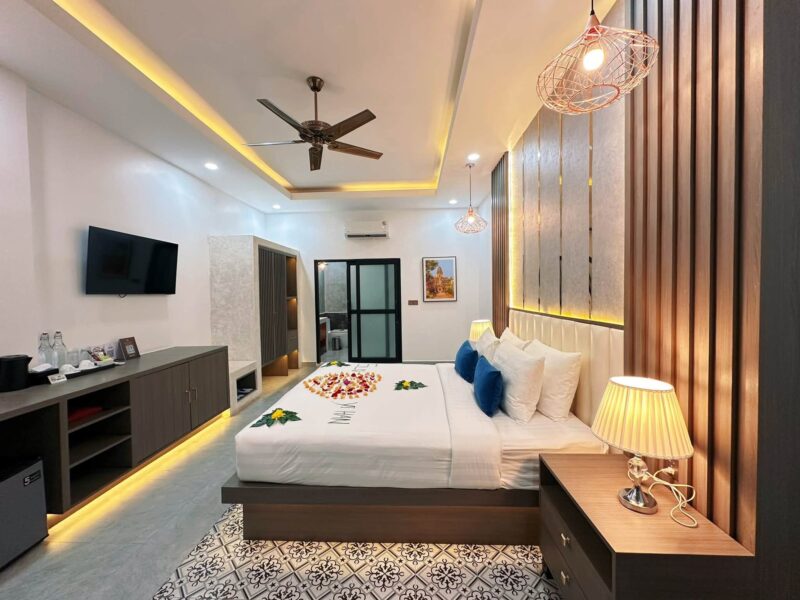
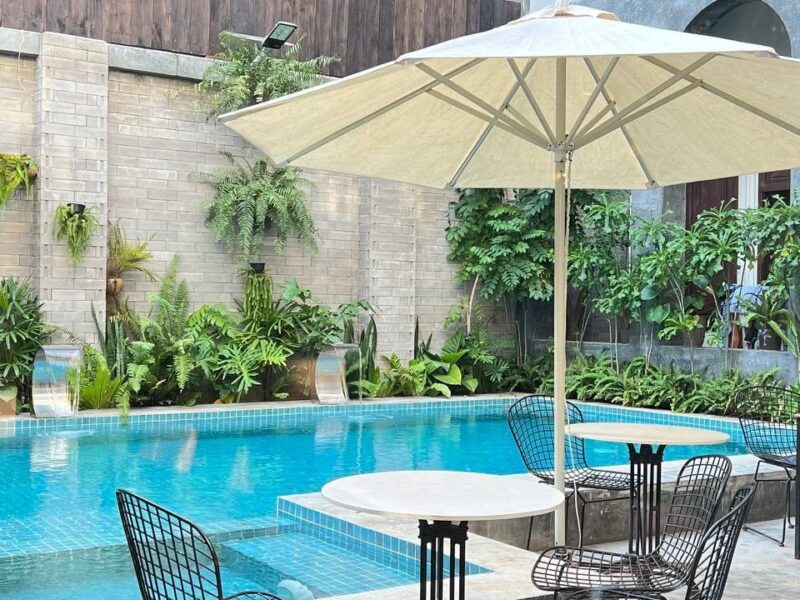
You sleep in hotels throughout, twin share, in an air-conditioned room wherever possible. Couples share a room, and a single room can be arranged for a supplement listed on each ride’s page. The rides from Siem Reap stay two nights there, one in Battambang, one in Pursat, where the hotel has a swimming pool and a massage spa, and two in Phnom Penh. The longer rides add three nights in Kampot. Hotels and restaurants are examples and may change.
Siem Reap Bayon Modern
Battambang Cambana La Riviere
Pursat Pursat Riverside Hotel
Phnom Penh Check Inn
Kampot JBreak
04
How We Ride
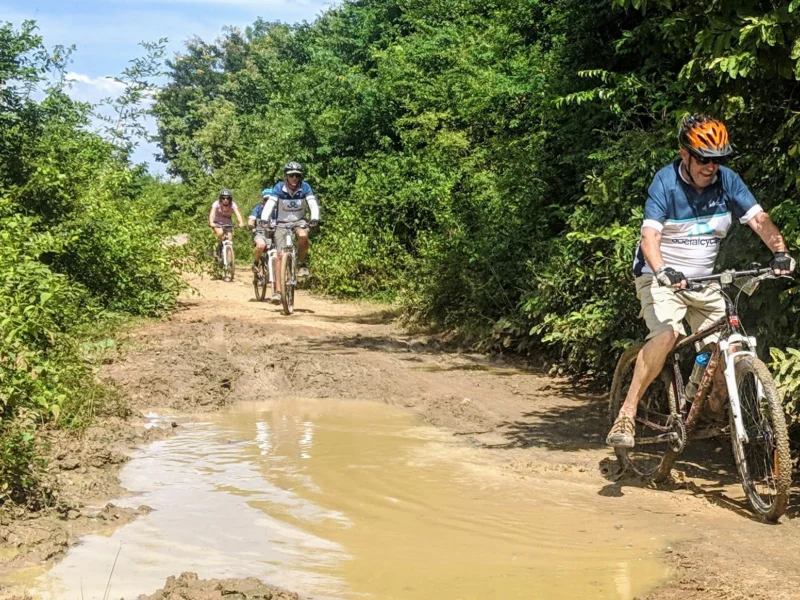
Cambodia is flat. You ride a mix of paved roads, compact gravel and dirt, with some single track, at an average pace of 15 to 18 km/h. Most riding days are 30 to 75 km, and the group usually stays together. The one climb, Bokor Mountain, is optional: 30 km to the top, the first 10 flat, or the van takes your bike up and you ride down. There is always a support van, which carries your bags and can carry you when you want a rest. You ride a 24-speed mountain bike, in a group of never more than 10 riders. E-bikes are available on the Cambodia rides.
Sunrise at the temples of Angkor, river roads and coffee stops around Battambang, then into Phnom Penh to meet Friends International. Cambodia’s highlights in a week.
The Bokor Mountain climb and pepper farms around Kampot, then over the border into the Mekong Delta for floating markets, a homestay in Ben Tre and the ride into Saigon.
Angkor to Saigon the long way: temples at sunrise, Battambang’s river roads and the Bokor climb in Kampot, then floating markets in the Mekong Delta and a homestay in Ben Tre.
Our Cambodia rides start in Siem Reap or Phnom Penh. Siem Reap’s airport is Siem Reap Angkor International (airport code SAI). Phnom Penh’s is Techo International (KTI), which took over from the old Pochentong airport in 2025. Check the code on your ticket, because the two Phnom Penh airports are not the same place. Most riders fly in through Singapore, Bangkok or Kuala Lumpur. We do not book flights, but tell us your arrival time once you have it.
Your arrival airport transfer is included. Once you have cleared immigration and collected your bags, look for the sign with your name on it in the arrivals hall, and wait there if you cannot see it straight away. Politely decline anyone offering you a taxi. We send you the local contact number before you fly. The transfer runs to the ride hotel on the arrival day, so if you are coming in earlier, book the same hotel through us and the transfer still applies, or arrange your own if you are staying elsewhere.
Departure transfers are not included: the hotel can book a taxi or tuk tuk to the airport. The rides that end in Phnom Penh finish with breakfast on the last day, and the Vietnam rides end in Ho Chi Minh City, where the same taxi rule applies.
If you are coming from Europe or North America, arrive a day or two early. It takes the edge off the jet lag before the first ride, and both Siem Reap and Phnom Penh have plenty to do. Ask us for a few ideas.
Visas and Entry
Most passport holders, including Australians, New Zealanders, Britons, Americans and Canadians, need a tourist visa for Cambodia. It is valid for 30 days and you can get it two ways: an e-visa online before you fly, or a visa on arrival at the airport. The e-visa is the easier option after a long flight. Apply on the official site, evisa.gov.kh, where the fee is shown as you apply, and allow at least a week; the site quotes approval within three business days. The visa on arrival is about 30 USD in cash at the airport, with a passport photo and the form you are given in the queue. Visa costs are not included in the ride price.
Separately, every traveller must complete the Cambodia e-Arrival card online within seven days before landing. It is free, and you keep the confirmation on your phone. Your passport needs at least six months’ validity from the day you enter. Hotels register foreign guests with immigration, so that is done for you at check-in.
If your ride continues to Vietnam, you need a Vietnam e-visa before the border day, and the application asks for your entry gate. The crossing is Ha Tien. The details are on Before You Go: Vietnam. Visa rules change, so check the official sites and the Smartraveller page for Cambodia before you book your flights.
Money and Tipping
Cambodia runs on the US dollar. Prices are quoted in dollars, you pay in dollars, and the local currency, the riel, comes back as your small change: about 4,000 riel to the dollar, so 1,000 riel is a quarter. You do not need to buy riel before you travel. Bring your dollars in clean, newer notes; a torn or marked note is often refused. You can change Australian dollars, euros and pounds in the cities, but small towns will only want US dollars.
ATMs are easy to find in Siem Reap, Phnom Penh, Battambang and Kampot and they pay out US dollars, with a fee of a few dollars per withdrawal on top of whatever your own bank charges. Cards are accepted in the bigger hotels and restaurants, but the places you are likely to spend money on the ride (a cafe, a market stall, a tuk tuk) are cash only. Tell your bank you are travelling.
Your meals, hotels and the support van are paid for, so your spending money covers lunches on the days they are not included, drinks, laundry, souvenirs and anything you do on your own. Most riders find a few hundred dollars for the ride is comfortable, and bring some home.
Tipping is not a custom in Cambodia. In restaurants and hotels nobody expects it, though some restaurants keep a tip box for exceptional service. The ride team is the exception. If you would like to tip the guides and the driver at the end, it is appreciated and never expected: riders typically give 0 to 100 USD per person, as the ride pages say. The team changes at the Vietnam border on the 12 and 16-day rides, so riders who tip usually do it twice.
Staying Connected
Buy a local SIM at the airport when you land, or ask us where to find one in town. The main networks are Cellcard, Smart and Metfone, and an airport kiosk will set you up with a data pack for the length of the ride for a few dollars; you need your passport to register it. Cellcard and Smart advertise eSIMs too, if your phone supports one and you would rather not swap cards. Check that your phone is unlocked before you leave home.
Wi-Fi is good and usually free in the hotels and cafes, even in small towns, but a SIM is still worth having. The group runs on a WhatsApp chat for the ride, and your guide can reach you if you are off exploring. There are no blocked websites to worry about.
Health and Insurance
See a travel doctor at least six weeks before you fly. There are no compulsory vaccinations for Cambodia, but a travel doctor will tell you what is recommended for you, and we can give you the route for the conversation. Malaria risk is low in the towns and along most of our route, and some riders choose to take tablets anyway. Whatever you decide, bring a tropical-strength insect repellent and cover up at dusk. Dengue is carried by day-biting mosquitoes in the wet season, and repellent and covering up are the defence.
Travel insurance is a condition of riding with us, and we ask for your policy details before the ride. Check that it covers cycling, medical treatment and evacuation, and keep a copy of the policy and the insurer’s emergency number with you. If something serious happens, it is your insurer who arranges and pays for an evacuation; we make the call on your behalf and work with them. The Smartraveller insurance guide explains what to look for.
Bring enough of any prescription medication for the whole trip, in its original packaging, plus a small first aid kit of your own: plasters for blisters, rehydration salts, anti-diarrhoea tablets, painkillers and sunscreen. A first aid kit travels with every ride and the guides are trained in first aid. A hospital or clinic is usually within two hours, and the guides know the nearest one. Drink two to four litres of water a day; the van carries plenty. Bottled water only, never the tap.
Smartraveller‘s advice for Cambodia is to exercise a high degree of caution, updated 22 September 2026. It also advises against travel within 50 km of the Thai border in seven western provinces, Battambang and Pursat among them, because of the armed conflict between Cambodia and Thailand. Our rides pass through the towns of Battambang and Pursat, and we check the route against the current advice before each departure; booked riders hear from us first if anything changes.
Weather and the Best Time to Ride
Cambodia is warm all year, and the question is really about rain and heat. The dry season runs from November to February: a few degrees cooler, especially at night, little rain, and the most visitors at Angkor. This is the classic time to ride and many of our departures fall in it. March and April are the hottest months, often above 35 degrees, and we do not run rides in April. The wet season, from June to October, is greener, quieter and still in the high 20s to low 30s. Rain usually comes as a late-afternoon downpour rather than a wet day, and after a storm there can be mud and a few flooded tracks on the single-track sections, which is part of the fun. In Brett’s words, there is never really a bad time to go, except maybe March and April.
For the numbers: Siem Reap’s average daily high runs from about 31 degrees in December to 36 in April, and the rain goes from under 10 mm a month in December and January to around 290 mm in September (Deutscher Wetterdienst long-term averages).
Everyone packs differently, so treat this as a starting point rather than a checklist. You will live in shorts, a t-shirt and sandals off the bike, and laundry is cheap and quick in every town we stay in, so you do not need a clean set for every day. The support van carries your bag, so a soft bag or a suitcase is fine, and a small daypack for the bike is useful.
On the Bike
A helmet (compulsory; bring your own if you can, though we have helmets on hand). Padded cycling shorts, or a gel seat cover if you prefer. Two or three light long-sleeved tops for sun protection, or cycling jerseys; we give you a Social Cycles jersey with back pockets. Closed shoes with a stiff sole: the bikes come with flat pedals, and you can bring your own pedals for clip-in shoes, though flats are the better choice on the single track. Cycling gloves, sunglasses, a cap or visor for under the helmet, and a light scarf or buff for your neck. A water bottle, sunscreen and lip balm.
Off the Bike
Light clothes for the evenings, and one outfit that covers your knees and shoulders for the temples. A light rain jacket in the wet season. Swimmers, because most of the hotels have a pool. Comfortable walking shoes or sandals. A hat.
The Small Things
Passport and a spare passport photo. A printed copy of your insurance policy. Your prescription medication and a small first aid kit. Tropical-strength insect repellent and hand sanitiser. Electrolyte sachets for the hot days. A power bank, your chargers and a travel adapter. A head torch for the homestay night on the Vietnam rides. Earplugs. A few US dollars in small notes for the first day.
What to Wear
Comfort first, then sun protection. Cambodia is a conservative country and people dress modestly, so away from the bike keep shorts to the knee and shoulders covered when you visit temples and villages. Short shorts and bare shoulders are not allowed in parts of Angkor Wat, and the guides will tell you the night before which days that matters. Shorts, t-shirts and singlets are fine for everyday wear. On the bike, long sleeves beat sunscreen alone, and the Khmer scarf you will see everyone wearing is the local answer to the sun on your neck.
Food and Drink
The food is one of the best parts of the ride. Dinners are ordered family style, with a spread of local dishes to share, and we often eat at the training restaurants run by the organisations we visit, because the food is as good as anywhere in town. Street food in the markets is part of the experience; follow your guide’s lead on where. Cambodian food is not especially spicy. Vegetarians are easy to cater for and there are vegetarian dishes on the table at every meal. If you have dietary requirements or allergies, tell us on the booking form once you have paid your deposit, and get in touch directly if an allergy is life-threatening.
Drink bottled water only, and plenty of it. Beer is cheap and cold, wine is harder to find and closer to home prices, and a cocktail in the right place is excellent. Go easy: a hot day on the bike and a couple of drinks make the next morning harder than it needs to be. Drinks with meals are not included.
Where We Sleep
We stay in clean, comfortable, air-conditioned hotels, usually with a pool, and always with a private bathroom. Rooms are twin share and couples share; a single room is available for a supplement, listed on each ride page. If you travel on your own you share with another solo rider of the same sex, and if there is no one to share with you do not pay the single supplement. The night at the family homestay in Ben Tre on the Vietnam rides is more basic, with a fan, a mosquito net and shared bathrooms. The hotels for each ride are on the Cambodia page.
Bathrooms and Laundry
Every hotel room has a Western toilet and a hot shower. Out on the road, village homes and local restaurants have squat toilets, and if you need one between stops the guides will find you a family happy to help. Carry tissues or toilet paper, and put it in the bin rather than the toilet, because the plumbing cannot take it. Laundry is available in every town we stay in, usually by the kilo and back the next day, so pack light and wash as you go.
Electricity and Charging
Cambodia is 230 volts, 50 hertz, and the sockets take the flat two-pin plug (type A) as well as the European round two-pin (type C), and many hotels have universal sockets; a universal adapter covers you. Bring your own adapter, as we do not carry spares. Hotel rooms have enough sockets for a phone and a camera. On the road, a power bank is the answer; the van has one slow charger, and it is shared.
Culture and Photography
Cambodians are warm and curious, and children will shout hello all day as you ride past villages. Wave back. A smile and a few words of Khmer, sua s’dei for hello and aw kun for thank you, go a long way. Take your shoes off where you see others do it, keep your voice down in temples, and do not touch anyone on the head.
Cambodia is wonderful to photograph. Ask before you photograph a person, and respect a no. Do not photograph children without a parent present and their consent: it is part of our child protection policy and the ChildSafe Movement’s tips for travellers explain why. On the visits to the organisations we support, we do not photograph children at all. If you want to give something, give it through the organisations we visit rather than to children on the street.
Shopping is good in Cambodia: coffee, Kampot pepper, silk, handicrafts and clothes. The social enterprise shops run by the organisations we visit, in Siem Reap and Phnom Penh, are the best place for gifts that do some good. Ask the guides where to go for what.
If Something Goes Wrong
Every ride carries a first aid kit and the guides are trained in first aid. For a cut, a sprain or a bout of dehydration, the nearest clinic or hospital is usually within two hours and the team takes you there. For anything serious, we contact your insurer and, if needed, your embassy, and we call the emergency contact you gave us on the booking form. Your insurer runs the evacuation; that is why we insist on travel insurance. On the bike, the support van is never far away, and a rider who has had enough for the day rides in it.
The Australian Government’s travel advice for Cambodia is on Smartraveller; we follow it, and so does your insurer.
You organise your own visa before the trip. Cambodia issues visas on arrival, and visa fees are not included in the ride price. Entry rules differ by nationality and can change, so check with the Cambodian embassy, or your own government’s travel advice, before you book flights. Australians can check Smartraveller, which we follow too.
How hard is the riding in Cambodia?
Cambodia is one of our easier rides. It is flat, and most riding days are 30 to 75 km on paved roads, compact gravel and some single track. The pace is casual and the group usually stays together. Each ride is planned to take most of the day, finishing around 3 or 4 pm, with time for coffee stops, photos and lunch.
Do I have to climb Bokor Mountain?
No. The Bokor climb is optional. It is 30 km to the top: the first 10 km are flat, and then it climbs all the way. If climbing isn’t for you, the van takes your bike up and you ride down. You can also take the day off the bike and spend it in Kampot.
What if I can’t ride the whole way?
There is a support van on every ride. It carries your bags and can carry you too when you want a rest. Sometimes it follows right behind. On the single tracks it meets the group at set points, usually no more than 20 to 25 km apart. Your tour leader can tell you what each leg involves before you start it.
How early is the Angkor sunrise ride, and is the ticket included?
You are on the bike from 4.30 am for sunrise over Angkor Wat, and you spend the rest of the morning riding between the other temples. The day is 30 to 40 km on flat, paved roads. Entry to Angkor Wat is included on the rides that start in Siem Reap.
What is the visit to S-21 like?
Tuol Sleng, also known as the S-21 Genocide Museum, covers the Khmer Rouge years. The visit is emotionally challenging, and we strongly recommend it. It follows a morning with Friends International, and the afternoon is left free so you have time to take it in before the group meets again for dinner. Entry is included.
Will we visit schools or meet children?
Not in the way some tours do. Under our child-protection policy, riders do not interact with children at schools or nurseries, and do not photograph children during NGO visits. At Chumkriel Language School in Kampot, no children are in attendance when we visit. Every group also attends a responsible-tourism presentation by Friends International or one of its official partners.
Can I hire an e-bike in Cambodia?
Yes. E-bikes are available on all four rides that include Cambodia, as an upgrade to the standard 24-speed mountain bike. The price of the upgrade is listed under Bikes & E-Bikes on each ride’s page. Standard bike hire is included in the ride price.
Do I need vaccinations for Cambodia?
That is a question for a travel doctor, ideally at least six weeks before you travel. Some countries require specific vaccinations, and a professional can tell you what is right for you. We are happy to provide route maps for your doctor. All riders give us their travel insurance details before the ride starts.