

FAQ & Travel Info
Everything riders ask before they book: how fit you need to be, what a riding day looks like, what to bring, how we look after your health and safety, and what the booking terms say. If your question is not here, ask us.
Is this the right adventure for you?
You need to be healthy and able to ride a bike. That is about the only requirement we have. Almost everyone who has ridden with us was nervous about the cycling before the first day, and people rarely find time to train for it. It is not a problem, because of the way we ride: the bike is a means of travel, a way to get off the beaten track, and the pace is casual and relaxed. There is always a support van if you want a break. If you like, we can drive you up the hills and you can ride down them.
Questions Riders Ask
How many kilometres do we cycle each day?
It depends on the trip. Cambodia and Vietnam are the easier rides: the terrain is mostly flat and the average is about 50 to 80 km a day. Laos, and the ride from Luang Prabang to Hanoi, are the most demanding, with longer days and a lot of climbing; the Luang Prabang to Hanoi leg has days of up to about 100 km. Each ride is designed to take most of the day whatever the distance, finishing around 3 or 4 pm, with time for breaks, photos, coffee stops and lunch built in. Each tour page lists the day-by-day distances.
What if I’m too slow and hold the group back?
This is by far the most common question, which might be some comfort in itself. We have a very relaxed attitude to the cycling. There are plenty of tours for riders who want to re-enact the Tour de France, and we are not one of them. We usually stay together, especially on the flats in Cambodia and Vietnam, where the route runs through a maze of single tracks and small back roads. Where there are hills (Laos, and Bokor in Cambodia) everyone rides at their own pace and we regroup at set points during the day.
What if I can’t (or don’t want to) cycle that far?
No problem at all. There is always a support van, which carries your bags and can carry you too when you want a rest. Sometimes it follows right behind; on some legs it meets us at set points up ahead, usually no more than 20 to 25 km apart, because of the single tracks we follow. Your tour leader can tell you what each leg involves and whether they think it might be a challenge for you.
How old is too old?
We never want to tell someone they are too old for one of our adventures. If you believe you can, you are welcome. If we don’t think a rider is up to a particular day, we will insist they take the van or the safest option, so each rider is judged case by case. The oldest person to ride with us was 84. She rode Laos, one of our hardest tours, and Cambodia to Vietnam. We have no upper age limit.
I don’t want to cycle, but my partner does. Can I still come?
In theory, yes, although it has not been done before. Some people book intending to sit in the van most days, but once they see how easy and fun the riding is they tend to get on a bike and never look back. Get in touch first, because different tours suit this differently and we would like to set your expectations accurately.
Can I bring my children?
It can be done, but talk to us directly first so we can set expectations about the riding and the experiences on the particular tour.
What bikes do we use? Can I bring my own?
We ride flat-bar mountain bikes on all our tours, with flat pedals and unisex saddles; the make varies by country, and frames run from small to XL. You are welcome to bring your own saddle, or your own pedals for clip-in shoes, although we recommend against clip-ins in Cambodia and Vietnam because of the terrain (make sure they are designed for mountain bikes; there can be some walking with the bike off the beaten track, and road shoes won’t cut it). Some riders bring a gel seat cover. You can bring your own bike if you really want to, but we only carry spares and tools for our own bikes, so you would need to bring your own spare parts and any special tools. Road bikes are not suitable for any of our tours. Where e-bikes are available, they are listed under Bikes & E-Bikes on the tour page.
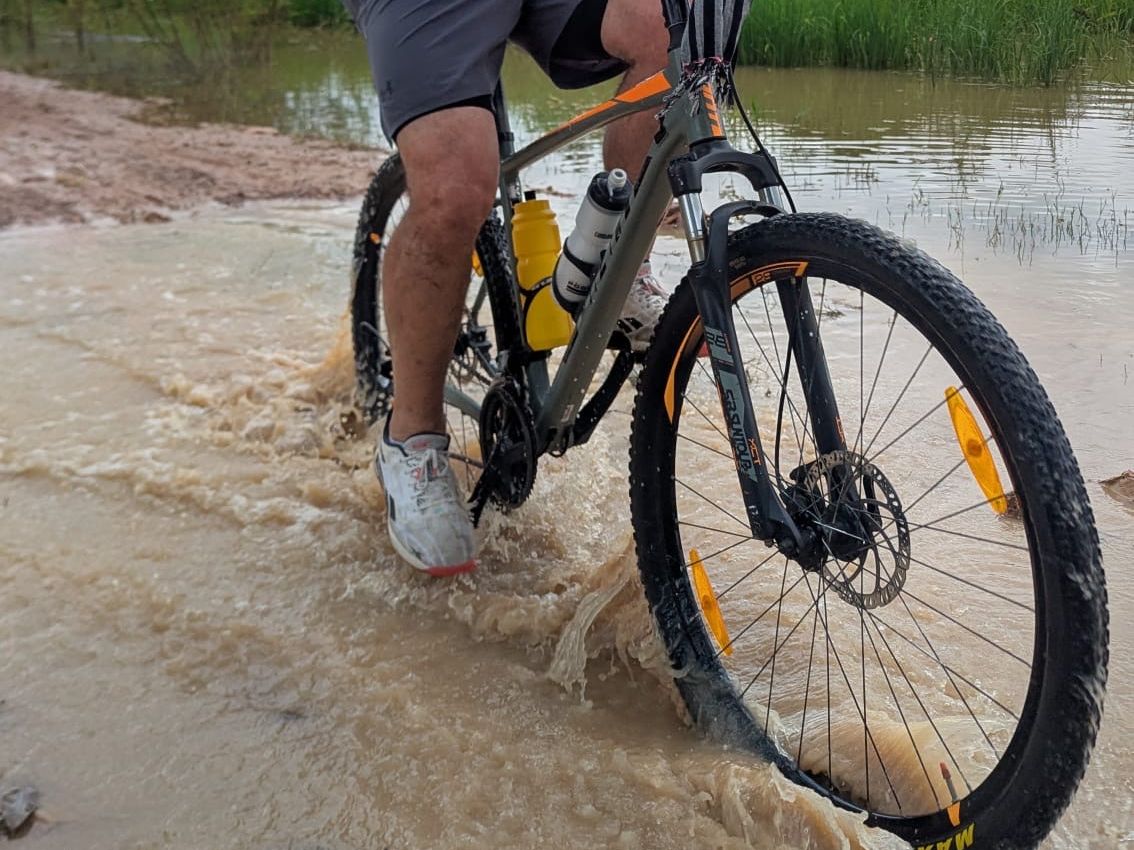
The Standard Bike
A flat-bar mountain bike with flat pedals and a unisex saddle, in frame sizes from small to XL. The make varies from country to country. Bike hire is included in the price of every ride. You are welcome to bring your own saddle or pedals.
One of our standard bikes.
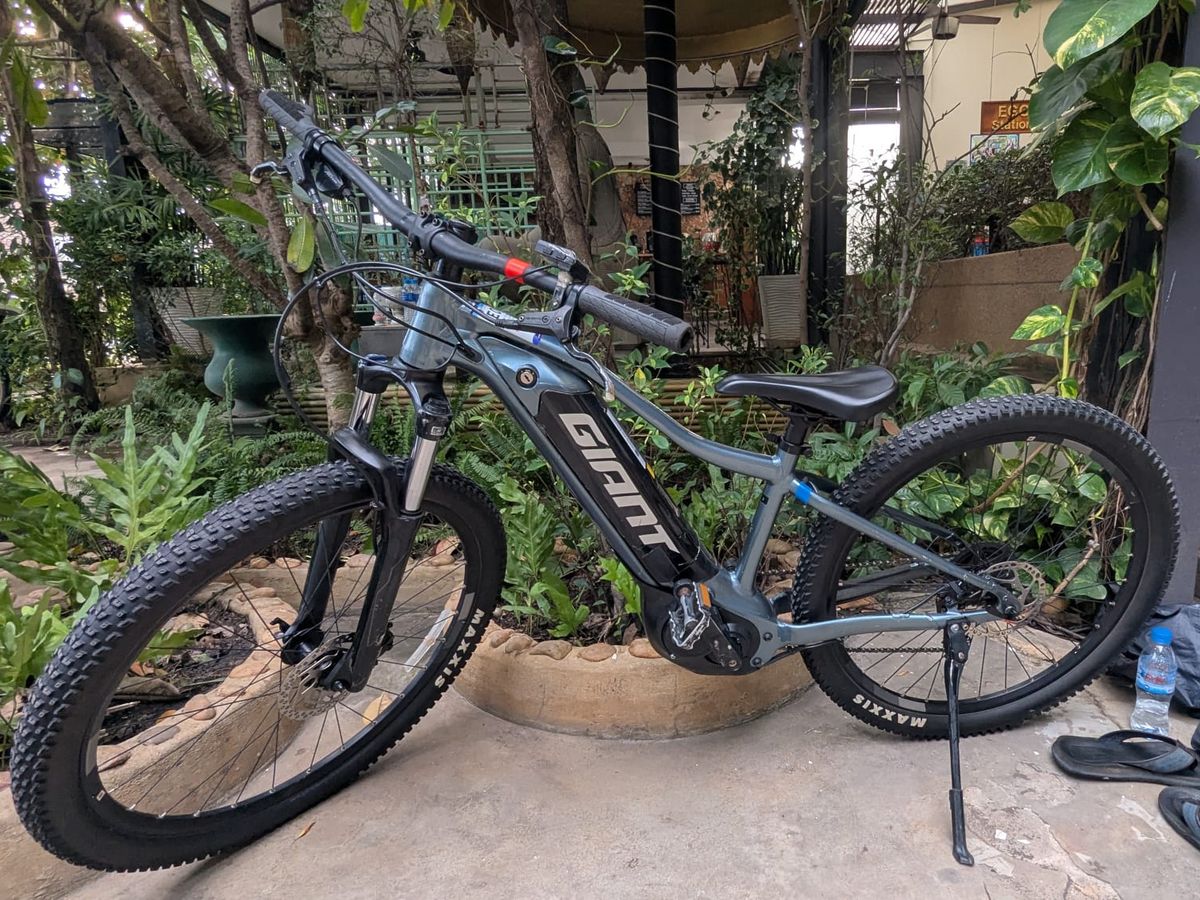
The E-Bike
A mountain bike with a motor that helps as you pedal. You still ride; the hills and the long days get easier.
One of our e-bikes.
Bikes shown are examples. The make and model on your ride may differ. Helmets are compulsory: we have some on hand, but bring your own if you can, so you know it fits.
What should I wear?
Two things matter: what you feel comfortable in, and what is culturally appropriate. Casual clothes are fine in South-East Asia: think shorts and a T-shirt. These countries can be a little conservative, though, so keep shorts to the knee and shoulders covered. Closed-toe shoes and a helmet are compulsory at all times during the trip. We recommend cycling gloves and padded shorts.
What should I pack?
We send detailed notes for each tour, but in general: pack light. A few lightweight shirts, one or two long-sleeved to keep the sun off, runners, shorts (it can get muddy) and something a bit fancier for dinner, and by fancy we mean anything other than your gym clothes. Toothpaste, moisturiser and other last-minute items are easy to buy in the larger cities. A small bottle of sunscreen, insect repellent and plasters are handy to carry. Bring a travel adapter for cameras and phones.
What are the sleeping arrangements?
Wherever possible you will be in an air-conditioned room. If you are travelling with your partner you share a room; otherwise prices are based on twin share. A single room can be arranged for a supplement, which varies by tour; where a price is published it is listed under Extras on the ride’s page, otherwise ask us. In Mongolia we stay in a mix of hotels, local ger camps and guesthouses.
What’s included in the tour price?
Check each itinerary, but in general: meals (most breakfasts and dinners, some lunches), all accommodation, bike hire, guides, a support vehicle to carry your bags, water and fruit on the ride, entry to particular local attractions with a specialist guide (Angkor Wat, for example), the NGO visits and your arrival transfer from the airport.
What’s not included?
Your flights, travel insurance, visa fees and guide tips. You will also need money for some meals, souvenirs and drinks. Drinks are not included with meals.
How does my donation work?
Every rider gives 200 AUD. It is a set donation, part of the trip, not an optional extra. It goes directly to the organisation you choose, all of it, with no bank fees and no commission. Near the end of the trip you pick which of the organisations you have met receives yours. It is your money and your call; no one decides for you.
Do I need a visa and vaccinations?
You organise your own visa before the trip. Cambodia and Laos issue visas on arrival; a Vietnam visa, where your nationality needs one, must be arranged before you arrive. See a travel doctor for vaccinations and medical advice, ideally at least six weeks before you travel.
How safe is it?
We will not run a trip where there is political unrest. The people in the countries we ride through are friendly and crime rates are low. We monitor the Australian Government’s Smartraveller advice for current, accurate information. We believe the countries we travel to expose riders to the same or similar risks as Australia, the UK or New Zealand. The health and safety notes below go into more detail.
Can I speak to somebody?
Of course. Brett Seychell, the founder, is the best place to start. Send a message or book a 15-minute call.
Health and Safety
We take your health and safety seriously. If you have a specific concern, please get in touch for a proper conversation before you book.
Before You Travel
See a travel doctor at least six weeks before departure. Some countries require specific vaccinations, and a professional can tell you what is right for you. Malaria is not prevalent in the areas our Cambodia and Vietnam rides pass through, although some riders choose to take medication anyway; we are happy to provide route maps for your doctor. All riders must give us their travel insurance details before the adventure starts. If you have any condition that could put you at greater risk of needing medical attention, tell us, so we can account for it in our risk assessment.
First Aid
A first aid kit travels with every tour and all our guides are trained in first aid. We still advise you to bring your own. A good kit has plasters (for blisters), triangular bandages, alcohol wipes, gauze pads, bandages for sprains, sunscreen, painkillers such as aspirin, anti-diarrhoea tablets and rehydration salts.
Local Hospitals
A hospital or medical centre is never far away, although standards may not be what you are used to. All our guides and drivers know the nearest hospital. Because we go quite far off the beaten track, it could be two to three hours away at most.
Cycling Briefings
We hold a thorough cycling briefing before every ride. Road rules, written and unwritten, differ between countries, so please pay attention during these. We cover the terrain, traffic and distance for the day, plus road rules, hand signals, group riding etiquette, pace and timing. Helmets and closed-toe shoes are compulsory at all times during the trip. We have helmets on hand, but we recommend bringing your own so you know it fits. Our routes use quiet back roads; we do not ride on highways, and unless a tour says otherwise we take the support van out of and into the major cities. Bikes are serviced between tours and a mechanic is with us on every ride.
Dehydration
Dehydration is potentially one of the biggest risks on a cycling adventure, because it is often the least considered. The countries we ride through are often humid and it can creep up on you. Every bike has at least one bottle cage; bring your own bottle. Aim for two to four litres of water on each riding day. Rehydration salts help, but if you drink enough, early enough, you should not need them. The van carries a drum of water for refills.
Water Safety
Sometimes we travel by boat, where the road floods or simply ends. All the boats we plan to use carry life jackets for riders who are not comfortable in the water. Occasionally unplanned flooding means a short ride (under 1 km) in a smaller boat, and there is no guarantee those carry life jackets, so if you are uncomfortable in the water, tell your guide. We don’t swim in rivers and lakes: the schedule rarely allows it, and they are the main source of insect-borne illness. The exception is Kuang Si Falls on the Laos rides, where you can swim.
Food
Food poisoning is the most common travel illness. Sometimes it is the food’s hygiene, but often it is cross-contamination from your own hands or simply a change of diet. Bring hand sanitiser and use it before meals. Eat where it is busy and the turnover is high; inspect the kitchen if you can. Food cooked to order carries less risk than a buffet. Ice is generally safe in the countries we visit, but do not drink tap water.
Political Unrest
For an independent view of the political situation in the countries we visit, we rely on the Australian Government’s Smartraveller advice rather than media reports. We will not run a trip where there is unrest.
Security
No country is completely safe, so take sensible precautions. In countries with a lot of motorbikes (Cambodia, Vietnam, Laos) the main risk is snatch-and-grab theft of cameras and phones from passing riders; theft involving assault is rare. Some hotels have a room safe; where there is none, valuables can be left in the room or with reception. Go easy on the alcohol while on tour.
Booking Terms
The booking terms and conditions, including deposits, payment and cancellation, are on the Terms & Conditions page. Read them before you book.