

Before You Go: Laos
The practical side of a Laos ride: getting in, visas, money, what to pack and what the weather does in the mountains. The day-by-day for each ride is on its own page: Laos, 11 days, Laos to Vietnam, 12 days and Laos to Vietnam, 20 days. If your ride crosses into Vietnam, read Before You Go: Vietnam as well. Anything we have missed, ask us.
Getting There
The Laos rides start in Vientiane or Luang Prabang. Vientiane’s airport is Wattay International (airport code VTE) and Luang Prabang’s is Luang Prabang International (LPQ). Both are small and easy, and both have flights from Bangkok, Hanoi, Kuala Lumpur and Singapore, which is how most riders arrive from Australia or Europe. We do not book flights, but tell us your arrival time once you have it.
Your arrival airport transfer is included. After immigration and bags, look for the sign with your name on it in the arrivals hall. Wait there if it takes a moment to find, and decline any taxi offers in between. We send you the local contact number before you fly. The transfer runs to the ride hotel on the arrival day. If you are coming in earlier, book the same hotel through us and the transfer still applies.
The rides end in Luang Prabang or, for the Vietnam rides, in Hanoi. Departure transfers are not included: the hotel will book a taxi to the airport. Luang Prabang deserves a few extra days if you have them, and we are happy to suggest what to do with them.
Visas and Entry
Most visitors, including Australians, New Zealanders, Britons, Americans and Canadians, need a tourist visa for Laos. There are two ways to get it. The official e-visa, at laoevisa.gov.la, is a single-entry tourist visa for a stay of up to 30 days. The site says approval usually takes three working days, you must enter within 60 days of approval, and you print the approval letter to show on arrival. It is valid at Wattay and Luang Prabang airports, which is where our rides begin. The other way is a visa on arrival at the same airports, paid in cash, in US dollars for preference. The fee varies by nationality, so check it on the e-visa site’s fee calculator before you fly and bring enough US dollars in cash for it. Your passport needs more than six months’ validity. Visa costs are not included in the ride price.
Laos also has an online immigration form, the LDIF, to complete within three days before you arrive. The Australian advice describes it as an alternative to the paper card and the British advice as a requirement, so fill it in and keep the QR code on your phone. If your ride continues into Vietnam, the crossing is at Tay Trang and you need a Vietnam e-visa before that day. The details are on Before You Go: Vietnam. Rules change, so check the official sites and the Smartraveller page for Laos before you book your flights.
Money and Tipping
The currency is the Lao kip. Rates move a lot, so treat about 22,000 kip to the US dollar as a rough guide. Kip is hard to buy outside Laos and hard to change back once you leave, so draw it as you go. ATMs are common in Vientiane, Vang Vieng, Phonsavan and Luang Prabang, with a small fee per withdrawal and a low cap on each one, plus whatever your own bank charges, and they are scarce in the small towns between. Cash does almost everything, and cards work in the bigger hotels and restaurants. Thai baht and US dollars are accepted in some places, especially near the Thai border, but kip is what you want for the markets and the small-town cafes. Bring your dollars in clean, newer notes, and tell your bank you are travelling.
Your meals, hotels and the support van are paid for, so your spending money covers the lunches that are not included, drinks, laundry, souvenirs and your own excursions. A couple of hundred dollars’ worth of kip over the ride is comfortable for most riders.
Tipping is not a custom in Laos, and nobody in a restaurant or a hotel expects it. The ride team is different. If you would like to tip the guides and the driver at the end of the ride, it is appreciated and never expected. Riders typically give 0 to 100 USD per person, as the ride pages say. On the Vietnam rides the team changes at the border, so riders who tip usually do it twice.
Staying Connected
Buy a local SIM at the airport when you land. The main networks are Unitel, Lao Telecom and ETL. A tourist data pack for the length of the ride costs a few dollars, and you need your passport to register it. eSIMs are less common here than in Cambodia or Vietnam, and a physical SIM from the airport kiosk is the reliable choice. Check that your phone is unlocked before you leave home. Coverage is good in the towns and along the main roads and drops out in the mountains and at the village homestay, which is no bad thing.
Wi-Fi is free in the hotels and most cafes. The group runs on a WhatsApp chat for the ride, so a SIM is worth having, and your guide can reach you if you are off exploring.
Health and Insurance
See a travel doctor at least six weeks before you fly. There are no compulsory vaccinations for Laos, but a travel doctor will tell you what is recommended for you, and we can give you the route for the conversation. Malaria is rare in the north, where we ride, and absent from Vientiane and Luang Prabang, though some riders take tablets anyway. Either way, bring a tropical-strength insect repellent and cover up at dusk, because dengue is around in the wet season and repellent and covering up are the defence.
Travel insurance is a condition of riding with us, and we ask for your policy details before the ride. Check that it covers cycling, medical treatment and evacuation, and carry a copy of the policy and the insurer’s emergency number. If something serious happens, your insurer arranges and pays for an evacuation. We make the call on your behalf and work with them. The Smartraveller insurance guide explains what to look for.
Bring enough prescription medication for the whole trip, in its original packaging, and a small first aid kit of your own: plasters for blisters, rehydration salts, anti-diarrhoea tablets, painkillers and sunscreen. A first aid kit travels with every ride and the guides are trained in first aid. Hospitals are further apart in Laos than in Cambodia, and in the mountains the nearest one can be two or three hours away. The guides know where it is. Drink two to four litres of water a day, bottled only, and the van carries plenty. Swimming at Kuang Si Falls and the Vang Vieng lagoons is part of the ride. Elsewhere, stay out of rivers.
Laos still carries unexploded ordnance from the war, most of it in Xieng Khouang province around the Plain of Jars, which we visit. The rule is simple and the guides repeat it: stay on the roads, the tracks and the marked paths, and do not pick anything up. Smartraveller‘s advice for Laos is to exercise a high degree of caution, updated 18 August 2026, with higher levels for Xaisomboun province east of Vang Vieng and for the Bokeo border area in the far north, so read the regional detail. Its wording is the same: stay on established paths and roads, and do not touch unknown objects.
Weather and the Best Time to Ride
Laos has a cool dry season, a hot season and a wet season, and the mountains make all three more pronounced than the lowlands. November to February is the cool, dry riding season and the best time to come. Days are pleasant, the air is clear and the nights in the mountains are cold: in December and January it can be in the teens by day around Phonsavan and close to single figures at night, so pack a warm layer. March, April and May get hot and humid, and we do not ride in those months. The rains come from about June, mostly as afternoon and overnight downpours. By September and October the humidity eases and the cycling season starts again while the country is at its greenest. Most of our departures sit between October and February.
For the numbers: Luang Prabang’s average daily high runs from about 27 degrees in December to 35 in April, with under 30 mm of rain a month in December and January and around 330 mm in August (WMO long-term averages).
The departure months for each ride are on the Laos page and the dates page.
What to Pack
Pack for warm days and cool nights, and for rain if you are riding at either end of the wet season. The support van carries your bag, so a soft bag or a suitcase is fine, and a small daypack for the bike is useful. Laundry is easy in the towns, so you do not need a clean set for every day. The hills are real in Laos, so bring the kit you would wear for a long day at home rather than a short one.
On the Bike
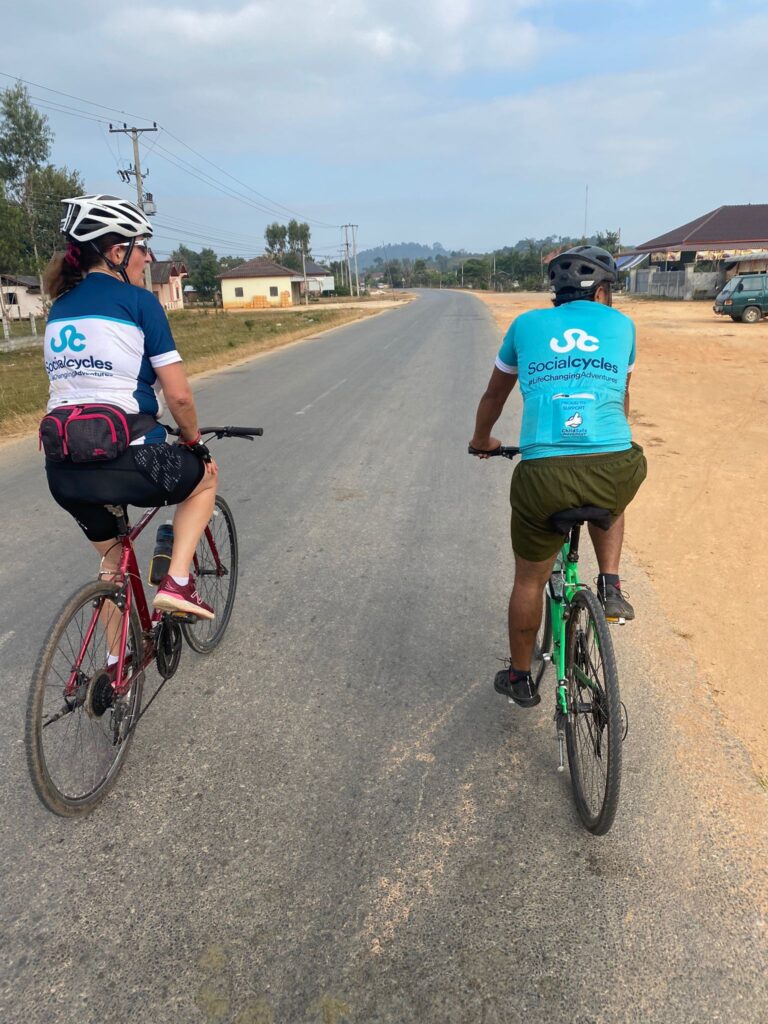
A helmet (compulsory; bring your own if you can, though we have helmets on hand). Padded cycling shorts, or a gel seat cover. Two or three light long-sleeved tops or jerseys for the sun, and we give you a Social Cycles jersey with back pockets. Closed shoes with a stiff sole: the bikes come with flat pedals, and you can bring your own pedals for clip-in shoes. Cycling gloves, sunglasses, a cap or visor for under the helmet, and a buff for your neck. Arm warmers or a light wind jacket for cool mountain mornings and long descents. A water bottle, sunscreen and lip balm.
Off the Bike
Light clothes for the evenings, and a warm layer, a fleece or a down jacket, for December and January nights in the mountains. One outfit that covers your knees and shoulders for the temples. A rain jacket. Swimmers for the falls and the hotel pools. Comfortable walking shoes or sandals. A hat.
The Small Things
Passport and a spare passport photo. A printed copy of your insurance policy and your e-visa approval. Prescription medication and a small first aid kit. Tropical-strength insect repellent and hand sanitiser. Electrolyte sachets. A power bank, your chargers and a travel adapter. A head torch for the homestay and the guesthouse towns. Earplugs. A quick-dry towel for the homestay on the northern rides. Some US dollars in small notes for the visa and the first day.
What to Wear
Comfort first, then sun. Laos is a conservative Buddhist country and people dress modestly, so away from the bike keep shorts to the knee and shoulders covered when you visit temples and villages, and the guides will tell you the night before which days that matters. Shorts, t-shirts and singlets are fine for everyday wear. On the bike, long sleeves beat sunscreen alone. In Luang Prabang, if you get up for the morning alms-giving, dress as you would for a temple and keep your distance from the monks.
Food and Drink
Lao food is fresh, herby and mostly unprocessed: sticky rice with everything, grilled fish and meat, laap, soups and mountains of greens and herbs. Dinners are ordered family style, with a spread of dishes to share. We eat at the training restaurants run by the organisations we visit in Vientiane and Luang Prabang, because the food is as good as anywhere in town. In the small towns the choice is simpler, and at the village homestay on the northern rides the family cooks for us. Vegetarians are easy to cater for and there are vegetarian dishes on the table at every meal. If you have dietary requirements or allergies, tell us on the booking form once you have paid your deposit, and get in touch directly if an allergy is life-threatening.
Drink bottled water only, and plenty of it. Beer Lao is cheap and cold, wine is scarce outside the cities, and coffee, grown in the south, is excellent. Go easy on the beer the night before a mountain day. Drinks with meals are not included.
Where We Sleep
Laos mixes comfortable town hotels, a rainforest resort and some simpler stops: guesthouses in the small towns of Kasi and Phonxai, and on the rides north of Luang Prabang a night in a village homestay at Nong Khuay and a basic guesthouse on the Nam Ou. Rooms are twin share and couples share. A single room is available for a supplement, listed on each ride page. If you travel on your own you share with another solo rider of the same sex, and if there is no one to share with you do not pay the single supplement. The guesthouse and homestay nights are clean and simple, with shared bathrooms and, at the homestay, mattresses on the floor and a mosquito net. The hotels for each ride are on the Laos page.
Bathrooms and Laundry
The hotels have Western toilets and hot showers. The guesthouses and the homestay have simpler, shared bathrooms, sometimes with a squat toilet and a scoop-and-bucket shower. Out on the road, local restaurants and village homes have squat toilets, and the guides will find you one when you need it. Carry tissues or toilet paper, and put it in the bin rather than the toilet, because the plumbing cannot take it. Laundry is available in every town we stay two nights in, by the kilo and back the next day.
Electricity and Charging
Laos is 230 volts, 50 hertz, and the sockets take the flat two-pin plug (type A) and the European round two-pin (type C), so a universal adapter covers you. Bring your own adapter, as we do not carry spares. The hotels have enough sockets for a phone and a camera, the guesthouses have fewer, and the homestay has one shared point at best, so a power bank is the answer on the road. The van has one slow charger and it is shared.
Culture and Photography
Lao people are gentle, unhurried and polite, and the pace rubs off. Sabaidee is hello, khop chai is thank you, and a nop, hands together with a small bow, goes with both. Take your shoes off at temples and in homes, keep your head lower than a monk’s or an elder’s where you can, and do not touch anyone on the head. In Luang Prabang the dawn alms-giving is a religious ritual, not a show: watch quietly from across the road, no flash, and do not buy rice from the touts to hand over.
Laos is beautiful to photograph. Ask before you photograph a person, and respect a no. Do not photograph children without a parent present and their consent. It is part of our child protection policy, and the ChildSafe Movement’s tips for travellers explain why. On the visits to the organisations we support, we do not photograph children at all. At the village homestay, the family will tell you what they are happy with.
Shopping is low-key but good: the night markets in Vientiane and Luang Prabang for handwoven textiles, silver and handicrafts, and locally grown coffee to take home. Many of the weaving and craft workshops run on fair-trade lines, and the guides can point you to them. Wood carvings can be a problem at Australian and New Zealand customs, so ask before you buy one.
If Something Goes Wrong
Every ride carries a first aid kit and the guides are trained in first aid. For a cut, a sprain or a bout of dehydration, the team takes you to the nearest clinic or hospital, which in the mountains can be two to three hours’ drive. For anything serious, we contact your insurer and, if needed, your embassy, and we call the emergency contact you gave us on the booking form. Your insurer runs the evacuation, which is why we insist on travel insurance. On the bike, the support van is never far away, and a rider who has had enough for the day rides in it.
The Australian Government’s travel advice for Laos is on Smartraveller; we follow it, and so does your insurer.